LUXURY HOTELS MAYFAIR
The Dorchester
Nearly a century of legendary hospitality on Hyde Park.
All of London / All of Mayfair / The Connaught / The Dorchester / The Beaumont
The Dorchester Hotel, Park Lane: London’s Most Storied Luxury Address
Since opening its doors in April 1931, The Dorchester has stood as one of the world’s most celebrated luxury hotels — a Park Lane landmark that has hosted royalty, heads of state, and Hollywood legends for nearly a century. It’s the kind of place where the history is embedded in the walls: where General Eisenhower planned military strategy, where Elizabeth Taylor celebrated and grieved, where the great and the glamorous have always chosen to be.
But The Dorchester is more than a monument to the past. Today, it holds three Michelin stars across its dining portfolio, operates one of London’s most lauded spas, and continues to attract guests who expect — and receive — a standard of service that most hotels can only approximate.
Among London’s great luxury hotels, each carries its own identity. Claridge’s is synonymous with Art Deco interiors; The Ritz with Edwardian grandeur; The Savoy with its Thames-side theatricality. The Dorchester’s distinction lies in a combination that none of its peers can quite replicate: wartime history woven into the building’s very structure, three-Michelin-starred dining under one roof, and a direct frontage onto Hyde Park that gives the hotel a sense of open space no amount of interior design can manufacture.
This guide covers everything worth knowing about The Dorchester: its history from construction to present day, its architecture and interior design, every dining venue, its rooms and suites, the spa, the celebrity culture, events, location logistics, and practical booking advice. Whether you’re planning a stay, a special dinner, or simply curious about one of London’s most storied addresses, this is the definitive resource.
The Dorchester
The Dorchester has been part of Park Lane since the 1930s, but after its recent renovation, it feels far fresher than many hotels of the same generation.
Quick Reference
- Address: 53 Park Lane, Mayfair, London W1K 1QA
- Phone: +44 (0)20 7629 8888
- Star Rating: Five-Star (Forbes Travel Guide)
- Price Range: Rooms from approx. £700/night
- Check-In: 3:00 PM | Check-Out: 12:00 PM
- Nearest Tube: Hyde Park Corner (5-min walk) / Marble Arch (10-min walk)
- Reservations: dorchestercollection.com
History of The Dorchester
Background: The Site Before the Hotel
Before The Dorchester existed, the site on Park Lane was occupied by Dorchester House — a grand Italianate mansion built in 1851 for the Holford family. It was, by all accounts, one of the finest private residences in Victorian London: lavishly decorated, architecturally ambitious, and firmly part of the social elite’s world. By the 1920s, however, maintaining such a vast private house had become financially untenable, and Dorchester House was demolished in 1929 to make way for something entirely different.
The decision to build a modern luxury hotel on the site was bold, but the location was impeccable. Park Lane, bordering Hyde Park, was already one of London’s most prestigious addresses. The question wasn’t whether a hotel would succeed here — it was whether anyone would be brave enough to build it.
Construction and Opening (1930–1931)
Construction began in 1930 under the direction of architects W. Curtis Green and Owen Williams. What made the build remarkable — and genuinely ahead of its time — was the structural approach: The Dorchester was constructed using reinforced concrete, then an unconventional method for a building of this type and scale. The technique gave the hotel a structural resilience that would prove unexpectedly valuable less than a decade later.
The hotel opened on 18 April 1931, right in the depths of the Great Depression. That timing sounds catastrophic, but The Dorchester defied the odds almost immediately. It positioned itself not as an extravagance but as a destination — a statement of confidence in London’s enduring appeal to international visitors and the British establishment alike. Within months, it had established itself as a social hub for the city’s most influential figures.
The Dorchester During World War II
The wartime chapter is perhaps the most extraordinary in the hotel’s history. When the Blitz began in 1940, The Dorchester’s reinforced-concrete construction made it one of the safest structures in central London — and that reputation drew some extraordinary guests. The hotel became a de facto diplomatic and military headquarters, hosting Allied commanders, government ministers, and foreign dignitaries who needed both security and discretion.
General Dwight D. Eisenhower used The Dorchester as his London base during the planning of Operation Overlord — the D-Day landings. General Omar Bradley and other senior Allied commanders were also among its wartime residents. Meanwhile, the hotel’s lower floors served as shelter during bombing raids, with staff and guests alike taking refuge in the converted basement spaces.
Perhaps equally striking is the social contrast: while London burned around it, The Dorchester hosted dinner parties, cocktail receptions, and gatherings where journalists, politicians, and diplomats mixed in an atmosphere that was simultaneously surreal and entirely in keeping with the British stiff-upper-lip tradition. The author Evelyn Waugh and the journalist Ed Murrow were among those who frequented the hotel during this period.
Post-War Transformation and Modern Ownership
After the war, The Dorchester underwent significant renovation and repositioning. The hotel passed through several ownership phases across the latter half of the twentieth century. In 1976, it was acquired by a consortium that included McAlpine and various international investors. A major restoration project followed in the 1980s, designed to bring the hotel’s interiors back to their original grandeur while incorporating modern amenities.
The most significant ownership change came in 1996, when the Brunei Investment Agency — the sovereign wealth fund of the Sultan of Brunei — acquired The Dorchester and incorporated it into what would become the Dorchester Collection, a portfolio of ultra-luxury hotels including The Beverly Hills Hotel, Hotel Bel-Air, Le Meurice in Paris, and Hotel Principe di Savoia in Milan. The Dorchester Collection now operates as one of the world’s most prestigious hotel groups.
Key Milestones
- 1851: Dorchester House built on the Park Lane site
- 1929: Dorchester House demolished
- 1931: The Dorchester opens, 18 April
- 1940–1945: Hotel serves as Allied military headquarters and wartime refuge
- 1980s: Major interior restoration
- 1996: Acquired by the Brunei Investment Agency
- 2007: Alain Ducasse at The Dorchester opens, eventually earning three Michelin stars
- Present: Operates as flagship property of the Dorchester Collection
Architecture and Design
Exterior: The Park Lane Facade
The Dorchester’s exterior is immediately recognisable — and deliberately understated for a building of its standing. The long, curved cream-coloured facade stretches along Park Lane with a quiet authority that doesn’t need to shout. Designed by W. Curtis Green, the building sits at eight storeys and presents a restrained neoclassical profile, its regular window rhythm broken by subtle decorative flourishes. It’s the kind of facade that ages well: not slavishly fashionable, not aggressively modern, but assured.
What makes it particularly distinctive is its relationship with its surroundings. On one side, the hotel faces Hyde Park directly — a rare urban luxury that gives the building a sense of breathing space no amount of interior design can manufacture. On the other, it anchors the Park Lane streetscape in a way that newer buildings in the area simply don’t.
Interior Design and Décor
The original interior was conceived by Oliver Hill, and it drew heavily on Art Deco influences — bold geometry, rich materials, and a sense of theatrical grandeur entirely in keeping with the spirit of the early 1930s. The interiors have evolved considerably since that 1931 opening, and tracing that evolution helps explain why the hotel feels both historic and alive today.
Hill’s Art Deco vision established the decorative grammar: geometric forms, gilded surfaces, and a confident use of pattern. The 1980s restoration — the most substantial redesign since the original opening — preserved that grammar while layering in Regency flourishes: classical motifs, richer colour palettes, and a greater emphasis on period antiques and decorative arts. Contemporary refinements since then have been deliberately light-handed, updating technology and soft furnishings without disturbing the underlying character. The result is an interior that reads as genuinely historic rather than period-themed, because the Art Deco bones and Regency details are original commitments rather than retrospective additions.
The colour palette tends toward warm golds, deep reds, and creams — opulent without being overwhelming. Floral arrangements throughout the public spaces are a signature detail, changed daily and designed by the hotel’s in-house florists with a level of care that most people only notice when it’s absent.
The Promenade and Grand Public Spaces
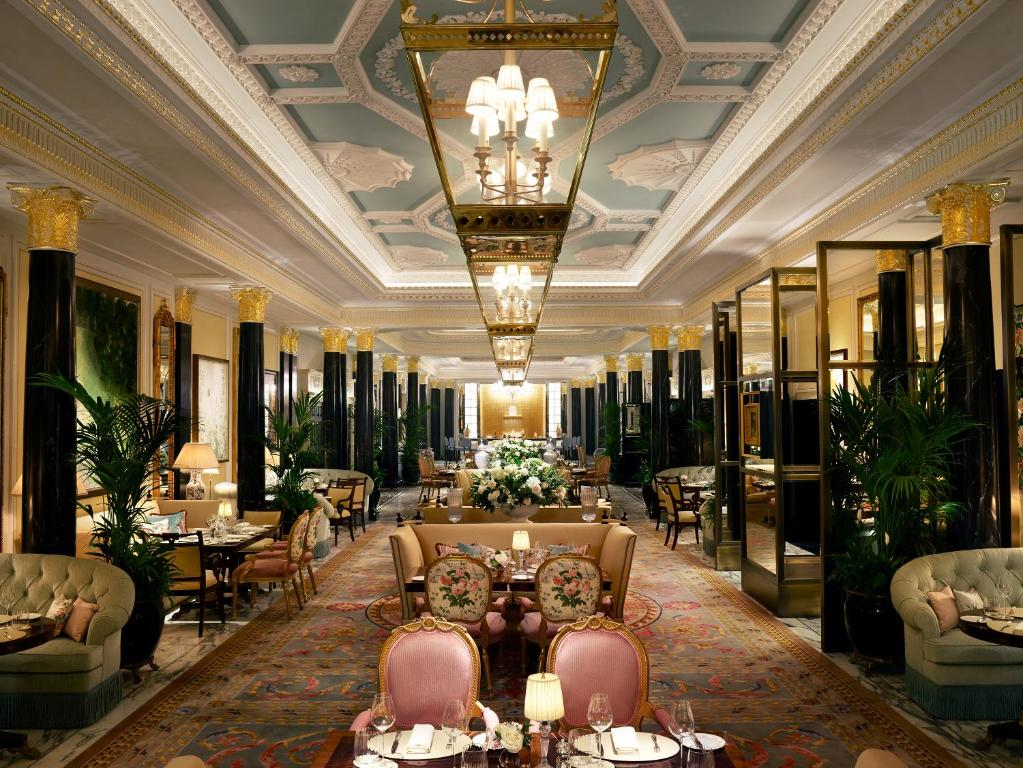
The Promenade is the social heart of The Dorchester — a long, gilded corridor of a room that runs through the centre of the hotel and serves as the setting for Afternoon Tea, casual meetings, and pre-dinner drinks. Its gilded columns, ornate ceiling, and carefully arranged seating have made it one of London’s most recognisable interior spaces. Spend an hour there on a weekday afternoon and you’ll understand why it has been a gathering point for London society for the better part of a century.
The ballroom is equally impressive — a vast, high-ceilinged space capable of hosting grand galas, charity dinners, and private events at a scale and standard that few venues in London can match.
Suite Design: Oliver Messel, Harlequin, and the Terrace Penthouse
Among the hotel’s most celebrated interior spaces are its signature suites. The Oliver Messel Suite — designed by the legendary theatrical designer of the same name — is arguably the most famous hotel room in London. Its hand-painted chinoiserie panels, silk fabrics, and theatrical attention to detail make it feel more like a stage set than a hotel room, in the best possible sense. It has hosted some of the most famous names in entertainment history.
The Harlequin Suite takes a bolder approach, with vivid colour and pattern that reflects its namesake’s theatrical origins. The Terrace Penthouse, meanwhile, occupies one of the hotel’s upper floors and offers direct access to a private outdoor terrace overlooking Hyde Park — one of the most coveted views in London.
The Grounds and Garden Terrace
The hotel’s garden terrace, facing Hyde Park, offers a rare outdoor escape in the middle of Mayfair. In warmer months, it becomes one of the more pleasant spots in central London for a drink or light meal — the proximity to the park lending the space a sense of calm that’s genuinely surprising given the location. It’s a detail that distinguishes The Dorchester from many of its Park Lane neighbours, most of which lack any meaningful outdoor space.
The Dorchester
The Dorchester has been part of Park Lane since the 1930s, but after its recent renovation, it feels far fresher than many hotels of the same generation.
Dining at The Dorchester
Alain Ducasse at The Dorchester: Three Michelin Stars
Let’s start with the headline. Alain Ducasse at The Dorchester holds three Michelin stars — a distinction shared by fewer than a dozen restaurants in the United Kingdom. It opened in 2007 when legendary French chef Alain Ducasse brought his culinary philosophy to London, and within a remarkably short time it had earned the kind of recognition that most restaurants never achieve.
The dining room itself is a statement: a fabric-draped, intimate space that feels deliberately removed from the grandeur of the hotel’s public areas. The focus is entirely on the food and the experience of eating it. The menu is rooted in classical French technique but shaped by seasonal British produce — the kind of cooking that requires both technical mastery and genuine restraint. Dishes are precise, beautiful, and delicious in a way that justifies the price and the formality. Reservations are essential and often need to be made weeks in advance.
The Dorchester Grill: British Fine Dining
The Dorchester Grill occupies a different register entirely — warmer, more accessible, but no less accomplished. Its heritage stretches back decades, and the restaurant has evolved to offer a modern British menu that draws on classical techniques without feeling nostalgic. The room has been refurbished in recent years with a bold, confident design that feels contemporary without abandoning the hotel’s characteristic sense of occasion.
For guests who want a proper, memorable dinner without the full formality of Alain Ducasse, The Grill is the natural choice. The seasonal menu, strong wine list, and attentive service make it one of the more reliable fine-dining experiences in Mayfair.
China Tang: Cantonese Elegance
China Tang is a different proposition again — and one of London’s most distinctive restaurant interiors. Designed by Sir David Tang, the room draws on 1930s Shanghai Art Deco for its aesthetic: lacquered panels, rich jewel tones, and a sense of glamour that feels genuinely transportive. The cuisine is Cantonese, and the kitchen takes it seriously: dim sum, Peking duck, and a broader menu of classic Cantonese dishes executed with care and consistency.
It’s worth knowing that China Tang has its own entrance from Park Lane, which means you don’t need to be a hotel guest to enjoy it — and many Londoners treat it as a standalone restaurant destination without ever connecting it to The Dorchester.
Afternoon Tea on The Promenade
Afternoon Tea at The Dorchester is, for many visitors, the primary reason to make the trip. Served daily on The Promenade, it’s one of London’s most celebrated Afternoon Tea experiences — and justifiably so. The sandwiches are freshly made, the scones arrive warm, and the pastries reflect a level of patisserie skill that you don’t always find even in five-star hotels.
The setting does a lot of work, too. The Promenade’s gilded columns, live piano music, and immaculate service create an atmosphere that feels special without being stuffy. Booking is strongly recommended — this is not a walk-in experience, particularly at weekends.
The Bar and Cocktail Culture
The Bar at The Dorchester has a celebrity history all of its own. Marlene Dietrich, Frank Sinatra, and countless film stars made it a regular stop during their London visits, and it has retained something of that golden-age glamour. The cocktail list is extensive and well-constructed, the service is knowledgeable, and the room’s intimate scale makes it feel like a genuine retreat from the city outside.
Signature cocktails here lean toward the classic end — perfectly executed Martinis, Negronis, and bespoke house creations — rather than the experimental foam-and-smoke theatrics that have become fashionable elsewhere. The classic cocktail focus is a deliberate choice that many guests find refreshing.
Private Dining
The Dorchester offers several private dining rooms for events ranging from intimate business dinners to larger celebrations. Each room is configured differently and can be catered by any of the hotel’s kitchen teams. The level of customisation available — menus, room layout, AV, floral design — is what you’d expect from a hotel that has been hosting high-stakes events for nearly a century.
Rooms, Suites, and Accommodation
Room Categories and Overview
The Dorchester offers 250 rooms and suites across several categories, ranging from Classic Rooms through Superior, Deluxe, and Executive rooms, up to a carefully curated collection of suites. The spread means there’s meaningful variation in both size and price — though it’s worth being clear that even the entry-level rooms are furnished and appointed to a standard that exceeds most five-star hotels.
All rooms feature marble bathrooms, bespoke furnishings, and the kind of attention to material quality that makes the difference between a hotel room that feels luxurious and one that merely claims to be. Thread counts, mattress quality, and lighting design are not afterthoughts here.
Signature Suites
The hotel’s most celebrated suites have already been touched on in the architecture section, but they deserve further attention from a guest perspective. The Oliver Messel Suite remains the most-requested room in the hotel — frequently booked months in advance by returning guests who won’t accept a substitute. Its theatrical design (hand-painted panels, antique mirrors, silk drapery) is genuinely unlike any other hotel room in London.
The Terrace Penthouse is the choice for guests who prioritise space and outdoor access. The private terrace, with its direct sightlines over Hyde Park, is spectacular at sunrise and magical at dusk. It’s the kind of room that makes you understand why certain guests return to The Dorchester year after year.
The Harlequin Suite offers a more playful, colour-saturated aesthetic — bold without being garish, and a favourite with guests in the creative industries. Each of the named suites has its own distinct personality, which is a rarer quality than it sounds: many luxury hotels offer ‘suites’ that are simply larger versions of the standard room.
Amenities and In-Room Features
Butler service is available across the suite categories, and the standard of that service is consistently cited in guest reviews as a genuine differentiator. The butlers at The Dorchester are not a decorative feature — they manage logistics, handle requests proactively, and operate with a discretion that high-profile guests particularly value.
In-room technology is kept refined rather than ostentatious: smart controls for lighting and temperature, high-quality audio systems, and reliable high-speed connectivity throughout. The emphasis is on comfort and functionality rather than gadgetry for its own sake.
Views: Hyde Park and Park Lane
Room selection at The Dorchester often comes down to the view. Hyde Park-facing rooms are the premium choice — the park’s tree canopy, the changing light through the seasons, and the sense of spatial relief it provides are genuinely valuable in a central London context. Park Lane-facing rooms offer a different but equally engaging urban perspective, particularly at night when the city’s energy is most visible.
If you’re booking and have a preference, it’s absolutely worth specifying this at the time of reservation — the concierge team is generally responsive to such requests, particularly if made in advance.
Accessibility and Family Accommodation
The Dorchester is equipped to accommodate guests with mobility requirements. Accessible rooms are available and feature adaptations including roll-in showers, wider doorways, and appropriate furniture configurations. Lift access serves all guest floors, and the team can arrange mobility assistance — including wheelchair support and personalised orientation on arrival — on request. Families travelling with children are also well catered for: interconnecting rooms can be configured to create flexible family layouts, and certain suites offer the space and separation that families find particularly practical. The hotel’s concierge team is experienced in arranging children’s amenities and age-appropriate recommendations for nearby activities.
Which Room Is Right for You?
Choosing a room at The Dorchester is easier when you map the options to the occasion. Classic and Superior rooms suit short business stays where comfort matters but space is secondary. For a romantic break, a Hyde Park-facing Deluxe room delivers the combination of views, atmosphere, and room quality that makes a weekend feel genuinely special. The Oliver Messel Suite is the natural choice for milestone celebrations — anniversaries, proposals, significant birthdays — where the room itself is part of the occasion. The Terrace Penthouse suits guests who prioritise outdoor space and privacy above all else. The Harlequin Suite appeals to those who want bold character rather than classical restraint.
The Dorchester
The Dorchester has been part of Park Lane since the 1930s, but after its recent renovation, it feels far fresher than many hotels of the same generation.
The Spa and Wellness at The Dorchester
The Dorchester Spa: Treatments and Facilities
The Dorchester Spa occupies a dedicated floor of the hotel and offers a treatment menu that covers the full spectrum of luxury wellness: facials, body treatments, massage therapies, and beauty services. The treatment rooms are designed with the same attention to material quality and atmospheric detail that characterises the rest of the hotel, and the spa’s overall approach prioritises genuine restoration over superficial luxury.
Spa day packages are available to non-resident guests, which makes the facility accessible to Londoners and day visitors who aren’t staying at the hotel. These packages typically include use of the pool and gym alongside selected treatments, and they represent one of the more accessible entry points to The Dorchester experience.
Exclusive Beauty Partnerships: Bamford and Aromatherapy Associates
Two partnerships define the spa’s product philosophy. Bamford — the organic wellness brand founded by Carole Bamford and rooted in Cotswolds-sourced botanicals — supplies a range of treatments that prioritise natural, responsibly sourced ingredients. Bamford’s philosophy aligns closely with what luxury spa guests increasingly expect: provenance, integrity, and visible care in every formulation. Treatments using Bamford products include bespoke facial rituals tailored to individual skin concerns, with protocols that adapt to skin type and seasonal needs rather than following a fixed template.
Aromatherapy Associates, one of the most respected names in British wellness, underpins the spa’s body treatment and massage offering. Their essential oil blends — developed over decades of clinical and wellbeing research — form the basis of signature massage therapies at The Dorchester Spa, including the Deep Relax Ritual: a full-body treatment combining warm oil massage with Aromatherapy Associates’ signature De-Stress blend, designed to address both muscular tension and nervous system fatigue. These partnerships are meaningful because they signal a commitment to product quality that guests can verify independently — both brands carry significant credibility in the luxury wellness market.
The Pool and Fitness Centre
The swimming pool is modest by resort standards but well-maintained and rarely crowded — a genuine luxury in central London, where hotel pool access is often either non-existent or absurdly oversubscribed. The fitness centre is fully equipped with both cardio and strength training equipment, and personal training sessions can be arranged through the spa team.
Beauty Salon Services
The beauty salon offers hair, nail, and makeup services — practical for guests attending events at the hotel or heading out for a significant evening in London. Pre-arrival booking is recommended, particularly for weekend appointments.
Sustainability at The Dorchester
The Dorchester Collection has made a series of public environmental commitments in recent years, reflecting growing awareness among luxury travellers of the environmental footprint of high-end hospitality. Initiatives include energy efficiency programmes across its properties, responsible sourcing policies in the hotel kitchens — with a focus on seasonal British produce and reduced food waste — and ongoing work toward reducing single-use plastics throughout operations. The Bamford partnership in the spa also reflects this direction: Bamford’s organic, sustainably sourced formulations align with the hotel’s broader commitment to responsible luxury. For guests to whom these credentials matter, the Dorchester Collection’s sustainability reporting is available on its official website.
Celebrity Culture and Notable Guests
Hollywood’s Favourite London Hotel
The Dorchester’s relationship with Hollywood is long, complicated, and well-documented. From the 1940s onwards, the hotel became the default London address for American film stars — partly because of its reputation for discretion, partly because of the quality of its suites, and partly because once a few famous names established it as the place to stay, others naturally followed.
Elizabeth Taylor and Richard Burton are perhaps the most storied of The Dorchester’s regulars. Their tumultuous relationship — two marriages, countless public scenes, and an enduring private bond — played out repeatedly at the hotel. Taylor reportedly stayed at The Dorchester during some of the most dramatic periods of her personal life, and the hotel’s staff became adept at managing the particular challenges that came with her presence.
Marlene Dietrich was a near-permanent resident for extended periods, and her relationship with The Bar became the stuff of hotel legend. Frank Sinatra, Judy Garland, and Cary Grant were all regulars. More recently, the hotel has maintained its status as the preferred London base for A-list film stars during the awards season circuit.
Royal Connections and State Visits
The Dorchester has hosted members of the British Royal Family on numerous occasions, and its proximity to Buckingham Palace — just a short drive through Hyde Park — makes it a natural choice for state occasions requiring accommodation for visiting dignitaries. Several heads of state have used the hotel’s suites during official London visits, and the hotel’s private dining and event facilities have hosted formal dinners at the highest diplomatic levels.
The BAFTA Connection and Awards Season
Every February, The Dorchester becomes the epicentre of London’s film industry social calendar. The proximity to the BAFTA ceremonies at the Royal Albert Hall and the Royal Opera House, combined with the hotel’s reputation and facilities, makes it the natural hub for the industry’s awards season gatherings. Studios book out blocks of rooms, parties fill the ballroom, and the hotel’s public spaces take on a particular energy during this period that’s unlike any other time of year.
Controversies and Cultural Moments
No account of The Dorchester’s cultural history would be complete without acknowledging the controversies that have surrounded it in recent decades. The hotel’s ownership by the Brunei Investment Agency — and by extension its connection to the Sultan of Brunei — has led to periodic entertainment industry boycotts, most notably in 2019 when the Sultan’s government introduced legislation imposing severe penalties under Islamic law. Several major studios, talent agencies, and individual celebrities publicly distanced themselves from the hotel during this period.
The Dorchester Collection responded with statements affirming its commitment to diversity and inclusion, but the controversy generated significant media coverage and remains a point of discussion among those who follow the hotel’s cultural standing. It’s a tension that hasn’t entirely resolved, and it’s worth being aware of for anyone with strong views on the matter.
Cultural References
The Dorchester appears in numerous works of fiction, journalism, and film as shorthand for a particular kind of London establishment luxury. References range from Ian Fleming’s James Bond universe to the pages of Tatler and beyond. Its cultural presence is, in many ways, as significant as its physical one.
Events, Weddings, and Private Hire
Weddings at The Dorchester
For couples considering The Dorchester as a wedding venue, the hotel offers a level of service and setting that is genuinely difficult to match in London. The dedicated events team manages everything from initial planning through to the final toast, and the range of spaces — from intimate private dining rooms to the grand ballroom — means the hotel can accommodate weddings of very different scales and styles.
The ballroom, in particular, has hosted some of London’s most spectacular weddings. Its high ceilings, chandeliers, and adaptable floor plan can be configured for ceremonies, receptions, and dinners with a flexibility that many dedicated wedding venues lack. The hotel’s catering — drawing on the culinary expertise of its kitchen teams — operates at a standard well above the typical wedding fare.
Corporate Events and Conferences
The Dorchester is equally well-equipped for corporate use. Its business facilities include meeting rooms of various sizes, full AV and presentation technology, and a level of logistical support that makes it a practical choice for high-stakes corporate events — product launches, board retreats, international conferences, and client entertainment. The hotel’s discretion and security protocols are also factors that make it attractive for sensitive business gatherings.
The Ballroom: London’s Most Glamorous Event Space
The Dorchester Ballroom has a history of hosting some of London’s most high-profile charity galas, industry dinners, and private celebrations. The annual Elton John AIDS Foundation fundraiser has been held here, as have numerous BAFTA-adjacent events and charity auctions. The combination of the room’s scale, the hotel’s catering capability, and the prestige of the address makes it a natural choice for events where the venue itself is part of the message.
How to Enquire
For events and wedding enquiries, The Dorchester’s dedicated events team can be contacted directly through the hotel’s official website or by calling the main reservations line. Initial consultations are complimentary, and the team is experienced in working with both detailed briefs and open-ended creative conversations about what’s possible.
The Dorchester
The Dorchester has been part of Park Lane since the 1930s, but after its recent renovation, it feels far fresher than many hotels of the same generation.
Location, Getting There, and Practical Information
Where Is The Dorchester?
The Dorchester is located at 53 Park Lane, Mayfair, London W1K 1QA. View on Google Maps The address places it at one of the most desirable intersections in the city: Park Lane to the west, with Hyde Park directly opposite, and the streets of Mayfair extending to the east. Bond Street, Berkeley Square, and the high-end boutiques of Mount Street are all within comfortable walking distance.
Getting There by Public Transport
Hyde Park Corner station (Piccadilly Line) is the closest Underground stop, approximately a five-minute walk from the hotel’s main entrance. Marble Arch station (Central Line) is also walkable at around ten minutes. Several bus routes run along Park Lane and Oxford Street, making the hotel accessible from most parts of central London without the need for a taxi.
For guests arriving at major London airports, the hotel’s concierge can arrange chauffeur transfers — Heathrow is approximately 45 minutes by car in normal traffic conditions, with the Heathrow Express to Paddington (followed by a short taxi ride) offering a faster alternative during peak hours.
Parking and Car Access
Valet parking is available at The Dorchester, which is a genuine convenience given that self-parking in Mayfair is both scarce and expensive. The hotel’s entrance on Park Lane allows for smooth vehicle access, and the valet team handles everything from that point. Guests arriving by chauffeur have a dedicated drop-off arrangement.
Nearby Attractions
Hyde Park is, quite literally, across the road — one of the hotel’s most significant geographical advantages. The Serpentine Gallery, the Diana Memorial Fountain, and the park’s cycling and walking paths are all within easy reach. Mayfair’s galleries, restaurants, and boutiques extend eastward, while Oxford Street’s major retailers are a short walk north. The hotel’s concierge team can arrange tickets, reservations, and guided experiences across the city.
Check-In, Check-Out, and Hotel Policies
Standard check-in is at 3:00 PM and check-out at 12:00 PM. Early check-in and late check-out can often be arranged, subject to availability — and it’s worth requesting these at the time of booking rather than on arrival. The hotel operates a smart-casual dress code in its public areas during the evening, and specific restaurants have their own requirements (Alain Ducasse, for instance, expects formal attire).
Booking The Dorchester: Rates, Tips, and Best Practices
How to Book: Direct vs. Third-Party Platforms
The most reliable way to book The Dorchester is directly through the official Dorchester Collection website. Booking direct typically offers advantages that third-party platforms don’t: access to best-rate guarantees, complimentary upgrades when available, early check-in or late check-out where possible, and direct communication with the hotel’s reservations team before arrival.
That said, certain luxury travel agencies and concierge services — particularly those affiliated with Virtuoso or American Express Fine Hotels & Resorts — can offer additional perks (room upgrades, breakfast inclusions, hotel credits) that aren’t available through the official website. If you’re booking a significant stay, it’s worth comparing both routes.
Room Rate Ranges and What to Expect
The Dorchester operates at the upper end of London’s five-star market. Classic room rates typically begin from around £700–£900 per night, with Deluxe and Executive rooms moving upward from there. Suite rates vary considerably based on the specific suite, season, and availability — the Oliver Messel Suite and Terrace Penthouse are among the most expensive rooms in London, and rates reflect that accordingly.
These figures are indicative rather than fixed — The Dorchester, like all luxury hotels, uses dynamic pricing that responds to demand, season, and availability. The best approach is to check current rates directly with the hotel.
Best Times to Visit London and The Dorchester
London’s peak hotel season runs broadly from June through September, when demand from international tourists pushes both availability and pricing. February is another busy period — awards season (BAFTA in particular) means the hotel is frequently at or near capacity, and rates reflect this.
The shoulder seasons — late autumn and early spring — often represent the best combination of value and availability. October and November, in particular, see London at a more manageable pace without the bleakness of January. The hotel’s public spaces and restaurants are worth visiting at any time of year, but the garden terrace is obviously most enjoyable in warmer months.
Loyalty Programmes and Special Offers
The Dorchester Collection operates its own loyalty programme — Dorchester Collection Signature — which offers benefits including room upgrades, late check-out, and exclusive rates for repeat guests. For frequent visitors to the Dorchester Collection’s properties (which span London, Paris, Milan, Beverly Hills, and beyond), membership provides meaningful value over time.
The hotel also periodically offers seasonal promotions — particularly around the quieter winter months — that can make a stay more accessible. These are best found through the official website or by contacting the reservations team directly.
Insider Tips for the Best Experience
A few things worth knowing before you arrive. First, request your preferred room type, view, and floor at the time of booking — not on arrival. The reservations team is far better placed to accommodate specific preferences in advance than the front desk is on a busy check-in day.
Second, use the concierge pre-arrival. The Dorchester’s concierge team can arrange restaurant reservations (including at Alain Ducasse, which is notoriously difficult to book independently), theatre tickets, chauffeur transfers, and virtually anything else you might need. Contacting them a week before arrival rather than on the day makes a significant difference.
Third, don’t overlook the less-obvious experiences: Afternoon Tea on The Promenade, a cocktail at The Bar, or a morning walk through Hyde Park departing from the hotel’s garden terrace. Some of the best moments at The Dorchester aren’t the most expensive ones.
The Dorchester
The Dorchester has been part of Park Lane since the 1930s, but after its recent renovation, it feels far fresher than many hotels of the same generation.
Frequently Asked Questions
The Dorchester operates a smart-casual dress code in its public areas during the evening. Individual restaurants have their own requirements: Alain Ducasse at The Dorchester expects formal attire (jacket required for men), while The Dorchester Grill and China Tang are smart-casual. Guests are advised to check individual venue policies when booking.
Yes. The Dorchester offers valet parking via its Park Lane entrance. Self-parking in Mayfair is very limited and expensive, so the hotel’s valet service is the most practical option for guests arriving by car. Charges apply; contact the hotel for current rates.
The Dorchester is pet-friendly and welcomes well-behaved dogs. Specific arrangements — including bedding, bowls, and treats — can be pre-arranged through the concierge team. It’s advisable to notify the hotel of your pet when booking to ensure an appropriate room is allocated.
Yes. All of The Dorchester’s dining venues — including Alain Ducasse, The Dorchester Grill, China Tang, and Afternoon Tea on The Promenade — are open to non-residents. China Tang even has its own dedicated entrance directly from Park Lane. Reservations are strongly recommended for all venues.
Afternoon Tea on The Promenade is one of London’s most popular experiences. Booking at least two to four weeks in advance is recommended, and further ahead for weekend slots or during peak periods such as the Christmas season, Valentine’s Day, and the BAFTA awards week in February.
Yes. The Dorchester Spa offers spa day packages to non-resident guests, which typically include use of the pool, gym, and selected treatments. Pre-booking is essential, particularly for weekend appointments. Contact the spa team directly through the hotel’s website to check availability.
Tipping is discretionary in the UK. At The Dorchester, a service charge is typically added to restaurant bills (usually 12.5%). For other services — such as porters, valets, and spa therapists — a tip of £2–£5 is customary but never obligatory. Tipping at the bar is at your discretion.
Standard check-in is at 3:00 PM and check-out is at 12:00 PM (noon). Early check-in and late check-out can often be arranged subject to availability — it’s best to request these at the time of booking rather than on arrival to maximise the chances of the hotel accommodating the request.
Booking directly through the Dorchester Collection website (dorchestercollection.com) is generally the most reliable approach, offering best-rate guarantees and direct communication with the reservations team. Guests seeking additional perks such as complimentary breakfast or hotel credits may also find value through luxury travel consortia such as Virtuoso or Amex Fine Hotels & Resorts.
Classic rooms at The Dorchester start from approximately £700 per night, with Deluxe and Executive rooms priced higher. Suite rates vary significantly depending on the suite, season, and availability — the Oliver Messel Suite and Terrace Penthouse are among the most expensive rooms in London. Dynamic pricing means rates fluctuate; checking directly with the hotel gives the most accurate current figures.
The Dorchester is, in the most genuine sense, more than a hotel. It is a living piece of London’s cultural and social history — a building that has witnessed nearly a century of the city’s most significant moments, from wartime resilience to peacetime glamour, from royal occasions to Hollywood excess.
What’s remarkable is that it hasn’t traded on that history at the expense of the present. From the three Michelin stars of Alain Ducasse to the exquisite detail of the Oliver Messel Suite, The Dorchester continues to operate at the frontier of what luxury hospitality can actually mean. The history is the foundation; the standard of the present is what justifies the reverence.
Whether your interest is a landmark Afternoon Tea on The Promenade, a once-in-a-lifetime dinner at Alain Ducasse, a suite for a special occasion, or simply understanding what makes this particular Park Lane address so enduringly compelling — The Dorchester rewards the attention you bring to it.
Ready to experience The Dorchester for yourself? Explore room availability, dining reservations, and spa bookings on the official Dorchester Collection website — or use this guide to plan every detail of your visit before you arrive.